
Waste billing mistakes are easy to overlook and surprisingly easy to let expire. Whether you manage facilities, finance, or procurement, the financial impact of a waste invoice error depends on two separate questions: whether the error exists, and whether you caught it in time. In some jurisdictions, delayed reporting is itself a condition that reduces the credit you can recover. That makes invoice review a time-sensitive task, not just a periodic housekeeping chore.
This article explains how waste bills are structured, where errors hide, and what verified rules say about reporting, escalation, and documentation. Examples labeled as hypothetical are included only to illustrate arithmetic; they are not evidence of typical outcomes.
How Waste Bills Are Structured and Where Errors Hide
Understanding what a bill is required to show is the first step toward spotting what is wrong. Under Washington State UTC solid waste consumer rights rules, a regulated solid waste bill must separately list all rates and charges, show the dollar amount and percentage rate of any taxes or fees, identify the billing period, state the due date, and state the date the bill becomes past due. These are regulatory requirements specific to Washington state; other jurisdictions may have different or additional rules.
When a required line item is missing or bundled with another charge, it becomes harder to verify that each fee is correct. Comparing your bill against what it is required to show gives you a structured starting point for surfacing discrepancies without relying on memory or guesswork.
For commercial accounts, the underlying rate calculation can also be a source of error. In Prince William County, Virginia, businesses and nonprofits including schools and churches are assessed based on actual waste generation amounts per year, or an estimate that uses business type and square footage to determine the Single Family Equivalent waste generation rate, which is then multiplied by the single-family fee. If the business type or square footage on record is inaccurate, the SFE will be inaccurate, and the resulting fee will reflect that error. Verifying the inputs used to calculate your SFE is a separate check from verifying the arithmetic.
Hypothetical example only: suppose a facility is classified as a retail store when it actually operates as a warehouse, and those two categories carry different waste generation rates under the applicable schedule. Every billing cycle would carry a compounding error until the classification is corrected. This is illustrative; actual rates and classifications vary by jurisdiction and contract.
For more on reading the underlying structure of a waste bill, see How to Read a Waste Invoice.
The Serial Number Check: Matching Equipment to Billed Service
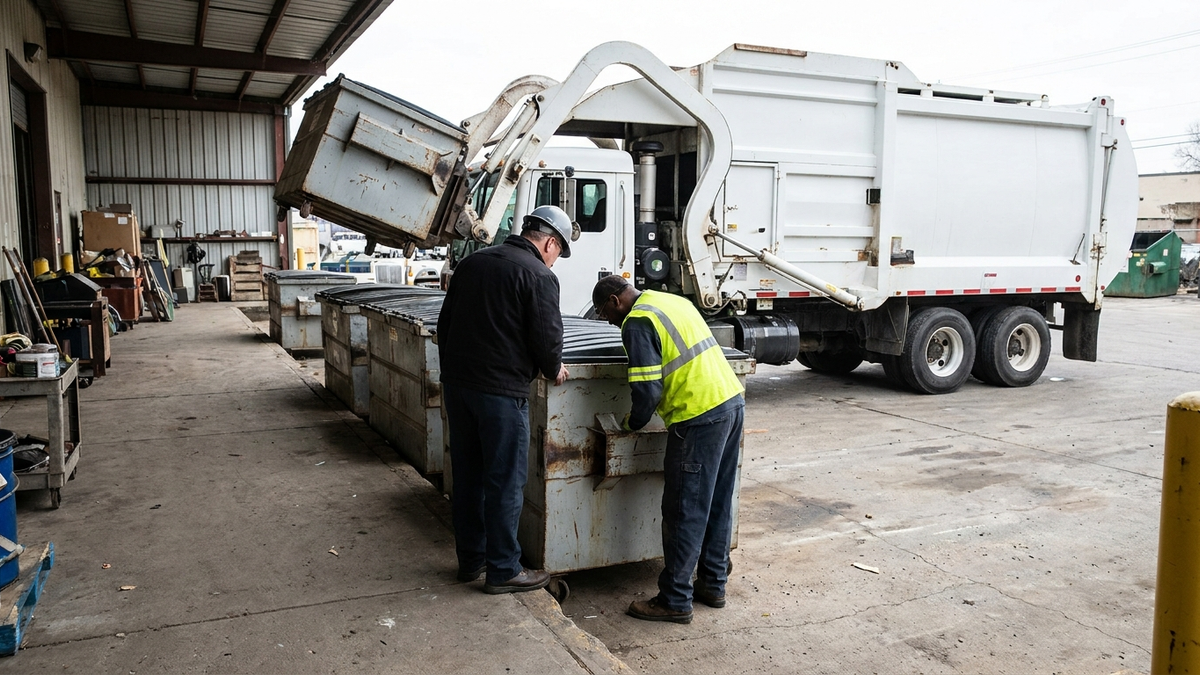
One verification method involves the physical equipment itself. According to City of Gainesville, Florida guidance for residential curbside collection, each garbage cart has a unique serial number, and residents can identify their assigned cart by matching that number with the refuse cart number printed on the monthly GRU utility bill. The first digit of the cart serial number indicates its size: 2 for 20 gallons, 3 for 35 gallons, 6 for 64 gallons, and 9 for 96 gallons.
This check applies specifically to Gainesville residential accounts as described in city guidance. If the size encoded in the serial number does not match the service level being billed, that mismatch is a reviewable discrepancy. Other jurisdictions and commercial contracts may have different or no equivalent check; verify what applies in your area.
A practical monthly checklist for this step might include: locate the cart serial number physically, find the corresponding number on the bill, confirm the first digit matches the billed container size, and note any discrepancy in writing with the date observed.
Timing Rules That Affect How Much Credit You Can Recover
This is where waste invoice errors carry a compounding financial risk that reviewers may not anticipate. Gainesville's guidance states that residents need to report billing errors or overcharges to the Solid Waste Division promptly in order to receive full credit. According to the City of Gainesville Billing and Special Service Requests page, delayed notification may result in only partial refuse credit to the account, and residents are responsible for checking their monthly billings to confirm that services provided correspond with rates charged at the time of service.
This rule is specific to Gainesville residential accounts as described in city guidance. It does not automatically apply to commercial contracts or other jurisdictions. However, it illustrates a category of rule that may exist elsewhere and that would not be visible on the invoice itself. If a similar condition exists in your contract or jurisdiction and you are unaware of it, you may recover less than the full value of a valid error.
The practical implication: knowing a billing error exists is not enough. The window within which you report it may determine how much you recover. Review cycles should be frequent enough that errors are caught and reported before any applicable deadline passes. Check your contract and local rules to determine whether a reporting window applies to your account.
For context on how software tools approach this problem, see Can Waste Invoice Software Pay for Itself? and Waste Invoice Audit Cost: Fees, Scope, and How to Compare Options.
How to Escalate a Dispute Step by Step
When an error is identified, the process of resolving it follows a sequence that regulators and municipalities may treat as important. The City of Sacramento's Commercial Waste Compliance guidance states that if a good faith effort to settle a dispute with your hauler has not resolved the issue, you may email the city's Commercial Waste Compliance team for technical assistance. The city strongly urges that written documentation, with email preferred, exist between you and your hauler before you contact the city.
This process applies to commercial waste accounts in Sacramento. Other cities and jurisdictions may have entirely different escalation paths, or none at all. Do not treat this as a universal requirement.
A general escalation sequence that reflects the structure in the Sacramento guidance, framed as a recommendation rather than a legal requirement, might look like this:
- Document the error in writing as soon as it is identified, noting the billing period, the specific line item, and the amount in dispute.
- Contact your hauler or billing department in writing, email preferred, with the documentation attached.
- Keep a record of every response or non-response, with dates.
- If the hauler does not resolve the dispute, check whether your city or county has a compliance contact and what documentation they require before you reach out.
- Submit your escalation only after you have assembled the written record the escalation body is likely to request.
Your jurisdiction may require different steps, different contacts, or different documentation. Check your contract and local rules before acting.
What Your Bill Must Show and How to Use That Against Errors
Returning to the structural requirements: the Washington UTC solid waste consumer rights rules require that every bill from a regulated company separately list all rates and charges, taxes and fees with both dollar amounts and percentage rates, the billing period, the due date, and the past-due date. These requirements exist so consumers can verify each element independently. They apply to UTC-regulated solid waste companies in Washington state; your jurisdiction may differ.
When you compare your bill against what it is required to show, missing or combined items become visible. A fee listed without a percentage rate, or a billing period that does not match the service dates you expected, is a starting point for inquiry. This does not prove an error occurred, but it identifies where to ask.
For commercial accounts in jurisdictions that use an SFE methodology, the rate calculation is a parallel check: verify that the business type and square footage on record are accurate, then verify that the published rate for that classification has been applied correctly. If your jurisdiction uses a different methodology, this framing may not apply.
Hypothetical example only: a nonprofit recorded at 5,000 square feet when its actual footprint is 8,000 square feet would carry an inaccurate SFE and potentially an incorrect fee in either direction depending on the rate structure. This is illustrative; do not treat it as a prediction of any specific outcome.
Reviewing your waste contracts before your next renewal is a related practice. See Before You Renew Your Waste Contract, Check These 12 Cost Traps for a structured look at what to examine.
Ready to review your waste invoices? Start an audit with Verdant.